Comets
Comet C/2025 A6 (Lemmon)
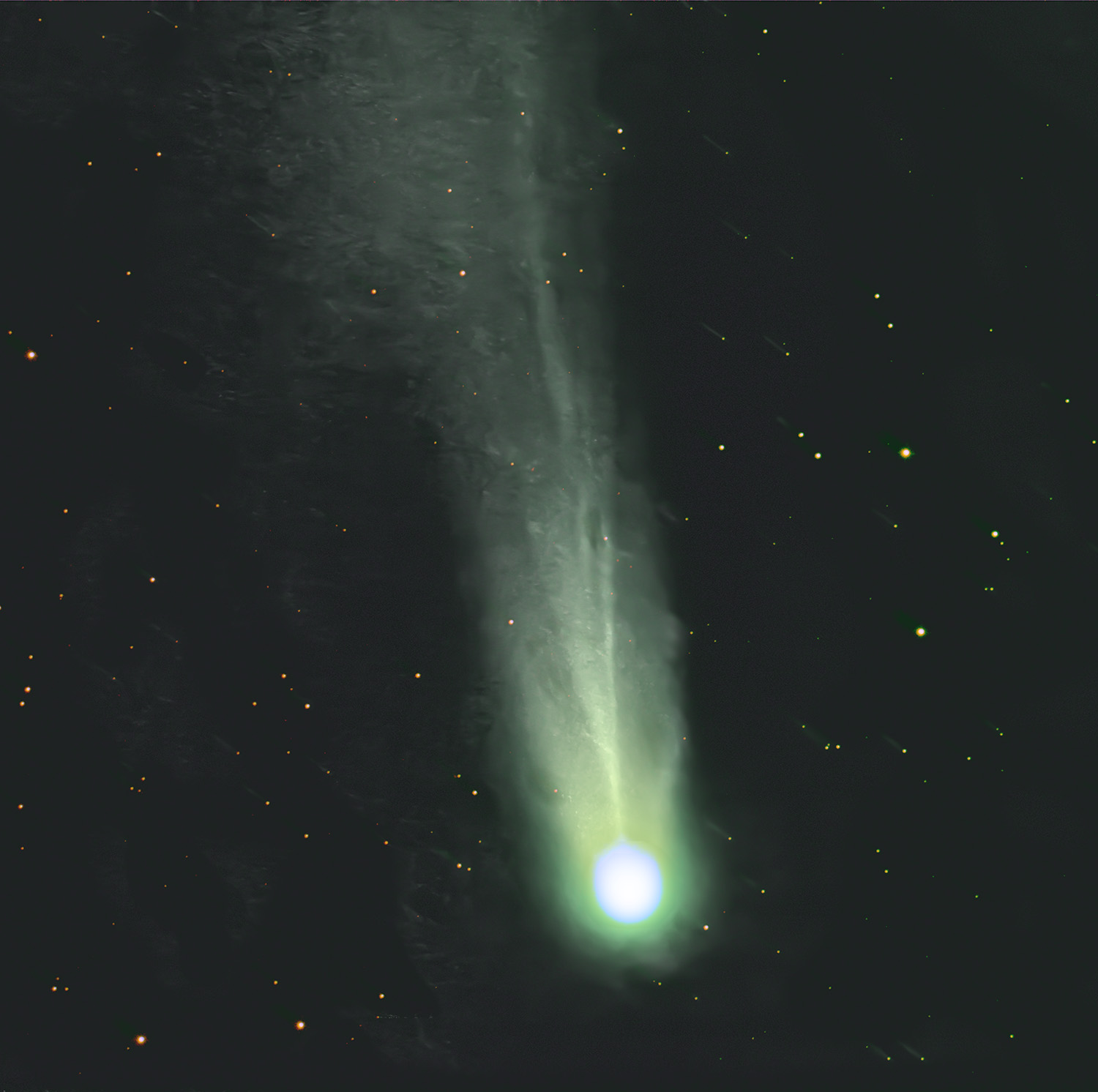
C/2025 A6, commonly known as Comet Lemmon, was discovered on 3 January 2025 by the Mount Lemmon Survey. It originates from the distant Oort Cloud and is on a long, highly eccentric orbit with a period of roughly 1 350 years, bringing it into the inner Solar System for the first time in many centuries.
On 16 and 17 October 2025, during my observations with a 200/1000 telescope and ASI2600 camera, Lemmon was still approaching both Earth and the Sun. At that time, it was not yet at its peak brightness: magnitudes reported in mid-October varied but were significantly fainter than the maximum later in the month (often cited around +5–+6). Around 16 October it was on the order of magnitude ~6–7, detectable with a decent telescope but not striking to the naked eye. Its heliocentric distance was gradually decreasing as it neared perihelion on 8 November 2025. It was roughly 0.7–0.8 AU from the Sun and several tenths of an AU from Earth in mid-October.
Lemmon passed closest to Earth (~0.60 AU) a few days later around 21 October, then continued inward toward the Sun before retreating back into the outer Solar System. Its long orbital period means it will not return for many centuries.
C/2025 A6, commonly known as Comet Lemmon, was discovered on 3 January 2025 by the Mount Lemmon Survey. It originates from the distant Oort Cloud and is on a long, highly eccentric orbit with a period of roughly 1 350 years, bringing it into the inner Solar System for the first time in many centuries.
On 16 and 17 October 2025, during my observations with a 200/1000 telescope and ASI2600 camera, Lemmon was still approaching both Earth and the Sun. At that time, it was not yet at its peak brightness: magnitudes reported in mid-October varied but were significantly fainter than the maximum later in the month (often cited around +5–+6). Around 16 October it was on the order of magnitude ~6–7, detectable with a decent telescope but not striking to the naked eye. Its heliocentric distance was gradually decreasing as it neared perihelion on 8 November 2025. It was roughly 0.7–0.8 AU from the Sun and several tenths of an AU from Earth in mid-October.
Lemmon passed closest to Earth (~0.60 AU) a few days later around 21 October, then continued inward toward the Sun before retreating back into the outer Solar System. Its long orbital period means it will not return for many centuries.
Comet C/2025 R2 (SWAN)
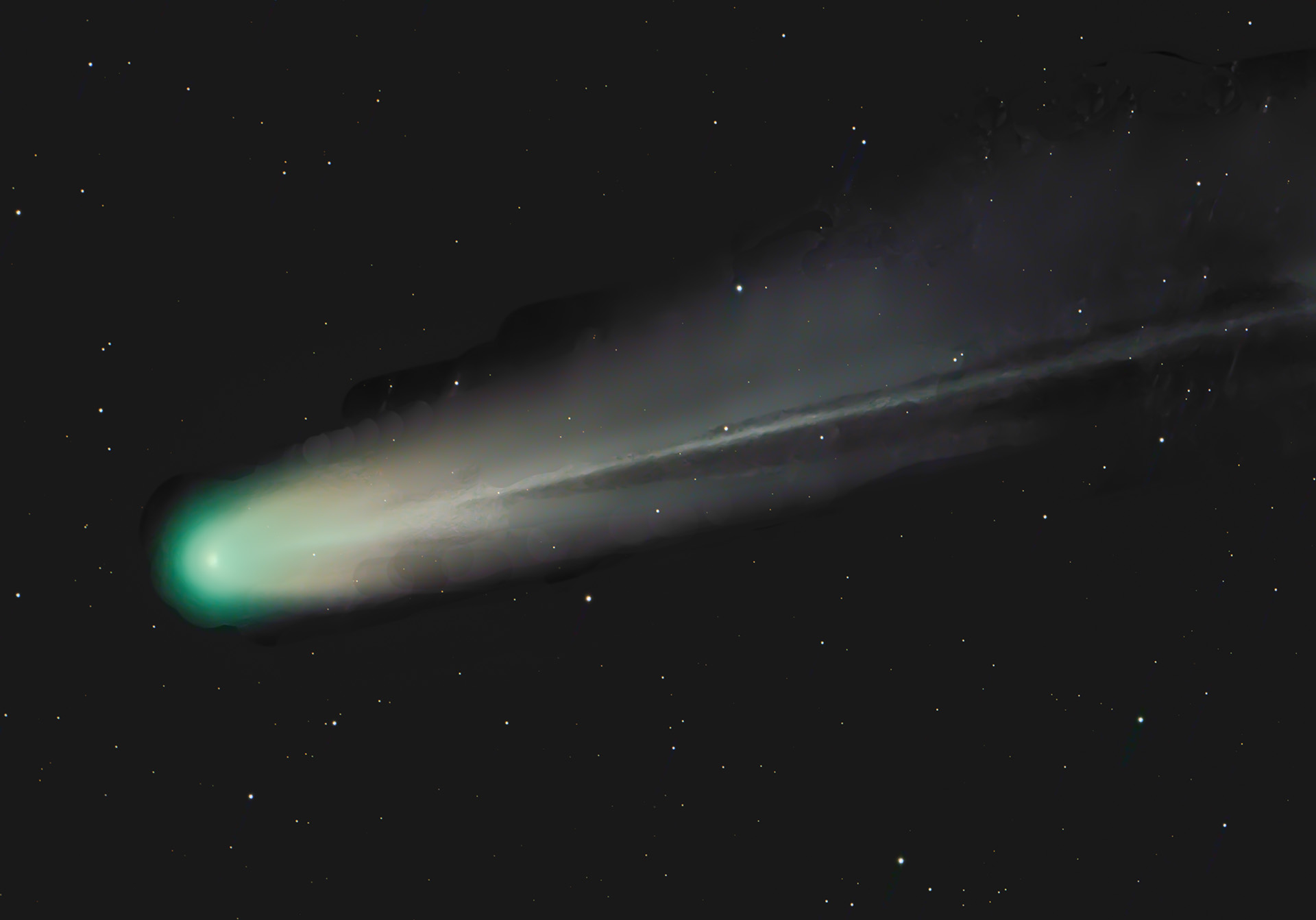
C/2025 R2, known as Comet SWAN, was discovered on 11 September 2025 in images from the SWAN instrument aboard the SOHO solar observatory by amateur astronomer Vladimir Bezugly. It is a long-period comet with an orbital period on the order of several hundred to a few thousand years, also originating from the distant reaches of the Solar System.
During my 17 October 2025 imaging session with the 200/1000 and ASI2600, SWAN was still on its way toward its closest approach to Earth (which occurred around 19–20 October 2025). In mid-October it was comparatively faint; typical reported magnitudes for SWAN around this epoch were in the +7 to +8 range, requiring telescopic imaging rather than naked-eye visibility. Its distance from Earth on 17 October was still significant, on the order of 0.3–0.4 AU, and its perihelion had already passed in mid-September at about 0.5 AU from the Sun.
After its closest approach, SWAN began receding from Earth and the Sun. It will likewise continue back toward the outer Solar System on its long orbit, with no imminent return expected on human timescales.
C/2025 R2, known as Comet SWAN, was discovered on 11 September 2025 in images from the SWAN instrument aboard the SOHO solar observatory by amateur astronomer Vladimir Bezugly. It is a long-period comet with an orbital period on the order of several hundred to a few thousand years, also originating from the distant reaches of the Solar System.
During my 17 October 2025 imaging session with the 200/1000 and ASI2600, SWAN was still on its way toward its closest approach to Earth (which occurred around 19–20 October 2025). In mid-October it was comparatively faint; typical reported magnitudes for SWAN around this epoch were in the +7 to +8 range, requiring telescopic imaging rather than naked-eye visibility. Its distance from Earth on 17 October was still significant, on the order of 0.3–0.4 AU, and its perihelion had already passed in mid-September at about 0.5 AU from the Sun.
After its closest approach, SWAN began receding from Earth and the Sun. It will likewise continue back toward the outer Solar System on its long orbit, with no imminent return expected on human timescales.